Why After-Hours Calls Still Cost Contact Centers Revenue
Blog
Read More
TL;DR
Global professional services network leader Deloitte lists at least 86 use cases for artificial intelligence (AI). Businesses across multiple industries employ AI for a variety of functions, from inventory optimization and supply chain operations to predictive maintenance, risk management, regulatory examinations and inspections, and more.
Call centers are increasingly adding AI to their operations to augment human agents, improve customer service, reduce costs, and provide customer service 24/7, even during peak operating hours. AI technology not only enables businesses of all sizes to achieve these advantages but also does so while improving data security and regulatory compliance.
In this guide, we’ll explain exactly what AI call centers are, what makes them different from traditional setups, and the advantages they offer, whether you operate in automotive, retail, restaurants, or another sector. You can also download our step-by-step guide to selecting the right AI call center vendor for your business.
An AI call center is a customer service platform that uses artificial intelligence to manage customer interactions across multiple channels, such as voice, email, chat, and SMS. Unlike traditional call centers that rely entirely on human agents or basic automated menus, an AI call center uses AI technology such as machine learning, voice recognition, and natural language processing (NLP) to automate and optimize how interactions are handled.
An AI call center is designed to:
AI call centers rely on several core technologies working together. Modern AI call centers leverage integrated and advanced AI tools to optimize operations, automate routine tasks, and enhance customer and agent experiences. Understanding these helps clarify why AI-powered contact centers are so different from their predecessors.
NLP is the branch of AI that enables computers to understand, interpret, and generate human language. In a call center context, NLP allows AI agents to parse the words a customer is saying and the meaning behind them.
Conversational AI leverages NLP and NLU to enable natural, human-like interactions between customers and AI agents, making conversations feel more intuitive and effective. Whereas NLP handles the mechanics of language, NLU focuses on intent (what the customer actually wants to accomplish). These technologies combine to allow an AI call center agent to understand a wide range of phrasings, accents, and conversational structures without requiring customers to speak in scripted commands.
Machine learning allows an AI contact center to improve over time. AI tools and center AI solutions use machine learning to continuously optimize call center operations and improve customer outcomes. By analyzing patterns across thousands of customer interactions, the system learns which responses are most effective, which workflows tend to break down, and where customers are most likely to abandon a conversation. This continuous improvement cycle means the AI call center becomes more accurate and more helpful the longer it runs.
Voice recognition technology converts spoken language into text so AI systems can process it. Modern voice recognition tools are far more accurate than earlier generations and are capable of handling background noise, multiple accents, and natural conversational pacing. This is what makes voice-based AI call center agents feel more like talking to a person than navigating an interactive voice response (IVR) menu. Advanced voice recognition technology also contributes to improved call quality by ensuring accurate understanding and response during customer interactions.
Predictive analytics uses historical customer data and behavioral patterns to anticipate what customers might need next. An AI contact center can use predictive analytics to forecast call volume by time of day or season, identify customers at risk of churn, suggest relevant product suggestions, or flag conversations that may escalate before they do, shifting the contact center from reactive to proactive.
AI contact centers can measure and analyze customer sentiment in real time to detect verbal cues, tone, word choice, and language patterns. AI-powered sentiment analysis can detect customer emotions and analyze customer conversations, providing deeper insights into customer needs and satisfaction. This equips them to assess how a customer is feeling during a conversation and allows the system to adjust its approach mid-interaction or escalate a conversation to a human agent when frustration is detected.
Modern contact centers powered by AI are transforming customer support by overcoming the limitations of traditional contact centers. While traditional contact centers rely on manual processes and human agents, modern contact centers leverage advanced technologies like intelligent routing, real-time analytics, and multilingual virtual agents to deliver seamless, efficient, and scalable customer experiences.
There are numerous differences between a traditional call center and an AI call center. Here is a side-by-side comparison:
| Feature | Traditional Call Center | AI Call Center |
|---|---|---|
| Availability | Business hours only | 24/7, no downtime |
| Scalability | Requires hiring more staff | Scales instantly with volume |
| Consistency | Varies by agent | Uniform across every interaction |
| Customer Wait Times | Often long during peak hours | Minimal, with instant response |
| Routine Task Handling | Requires agent time, manual routing | Fully automated with intelligent routing and AI-driven task assignment |
| Data Insights | Manual reporting, limited | Real-time, AI-driven analytics with agent availability tracking |
| Customer Sentiment Detection | Relies on agent intuition | Automated sentiment analysis |
| Personalization | Limited to agent knowledge | Driven by real-time customer data |
| Multilingual Support | Requires specialized agents | Built-in multilingual capability |
| Cost Over Time | Grows with headcount | Reduces with automation |
AI-driven intelligent routing ensures every call or chat is directed to the most appropriate virtual agent, self-service flow, or human representative with the right skills. Combined with real-time agent availability tracking, modern contact centers achieve higher First Call Resolution rates, improving customer satisfaction and operational efficiency.
IVR systems were once the standard for automating call center interactions. Customers would call in, listen to a menu of options, press a number, and get routed accordingly. IVR systems might reduce the load on human agents, but they often frustrate customers.
IVR systems force customers through a predetermined set of choices. If a customer’s need doesn’t fit neatly into one of the listed options or they want to change direction mid-call, the system can’t adequately respond, often requiring transfer to a human agent.
In an AI call center, customers speak naturally instead of navigating menus. The AI call center agent understands intent regardless of how the customer phrases their request.
Conversational AI enables natural, unscripted conversations and automates routine inquiries, making interactions smoother and more efficient. There are no rigid scripts or awkward silences.
Key ways AI call centers outperform IVR:
The term “AI agents” refers to AI systems capable of taking action. They complete tasks instead of just generating a response. AI-powered agents can automate routine inquiries and customer interactions, freeing up human agents to focus on more complex issues.
In a call center context, AI agents can book appointments, process orders, update records, and resolve customer inquiries across multiple systems without any human involvement. A chatbot answers questions, but an AI call center agent acts on them.
AI agents in a modern contact center can:
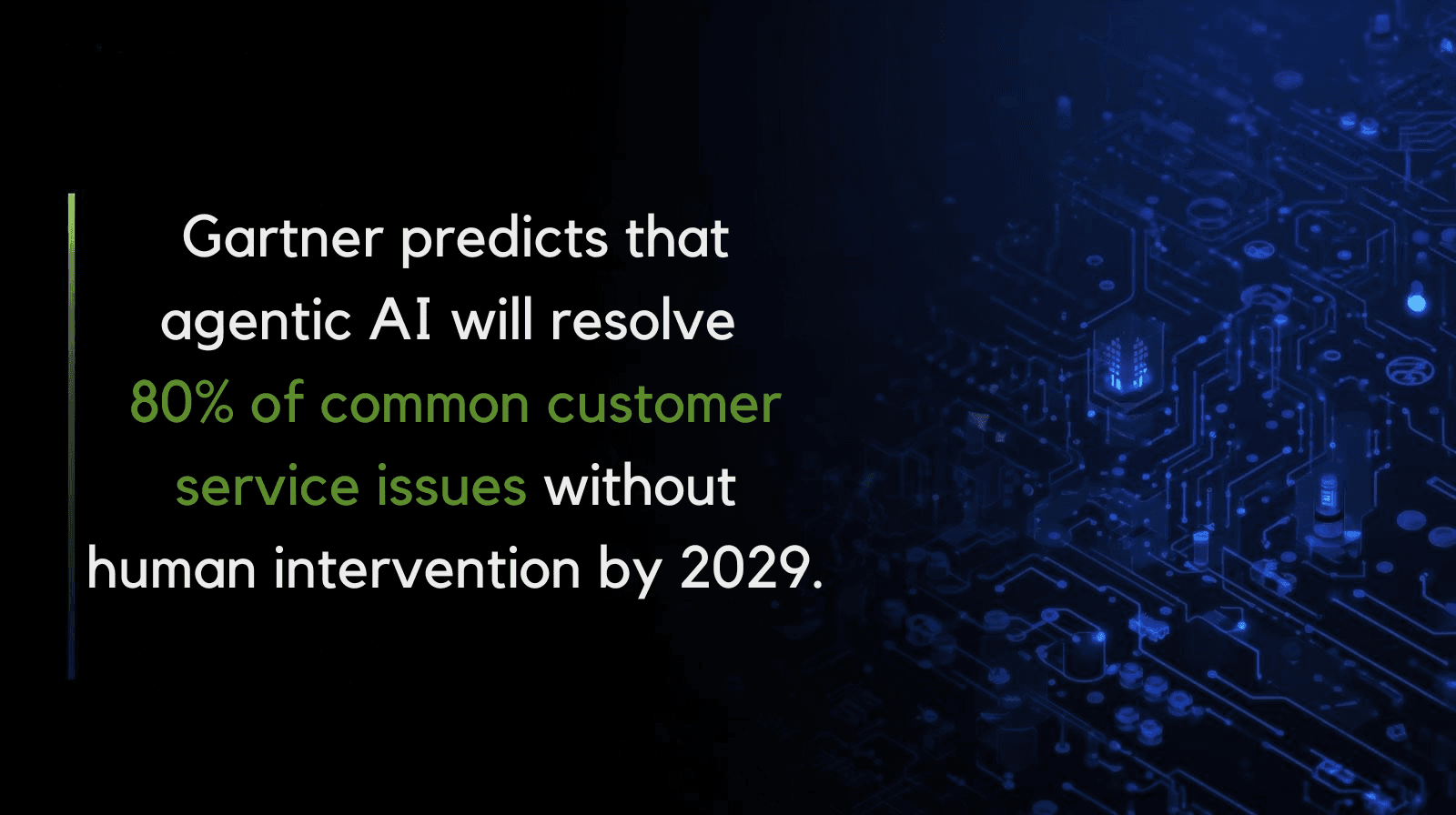
Gartner predicts agentic AI will resolve 80% of common customer service issues without human intervention by 2029, reducing operational costs by up to 30%. That’s a sizeable perk for businesses dealing with high call volumes and inconsistent service.
One of the biggest advantages of an AI call center is the ability to deliver personalized service at scale. AI call centers deliver personalized customer experiences by analyzing customer behavior and predicting customer needs, allowing businesses to tailor every interaction.
Traditional call centers are limited by what individual agents know and remember, but AI-powered contact centers have access to and use real-time customer data. By integrating with CRM platforms, loyalty systems, order histories, and service records, an AI call center agent can:
Personalized customer service is an expectation. Roughly 30% of consumers now say they trust brands more when AI is part of the experience, and 32% of consumers value AI when it saves them time. An AI call center provides consistent personalized service, no matter how or when a customer contacts a business.
Customers do not want to repeat themselves. They want the business to already know who they are and what they need. AI call center solutions make that possible at scale.
Improving customer satisfaction should be the primary goal of any call center. AI technology directly supports this goal in multiple ways. AI-powered solutions can analyze and improve customer service interactions through real-time analytics and quality assurance, ensuring every conversation meets high standards and identifying opportunities for improvement.
Faster response times are one of the clearest drivers of customer satisfaction. When a customer calls or texts, they want an answer quickly. AI contact centers provide immediate responses without hold music, wait queues, or callbacks.
Another major factor in customer satisfaction is consistency. In traditional call centers, the quality of service depends on which agent a customer reaches and his or her training. An AI call center delivers the same accurate answer every time in the same tone and across every location and channel. AI-driven solutions improve customer interactions and first call resolution by delivering accurate answers and reducing repeat contacts, ensuring customers get the help they need on the first try.
After-hours support also matters because customer inquiries don’t stop when the office closes. An AI call center handles after-hours calls by providing support around the clock and can generate automated call summaries to update human agents the next day. When AI is able to resolve routine interactions immediately and accurately, customer sentiment improves, repeat contact rates drop, and First Contact Resolution (FCR) rates increase.
A well-designed AI call center makes human agents more effective by handling the volume, complexity, and repetition that often burn them out. It does so while keeping them in the loop for conversations that require judgment, empathy, or nuanced decision-making.
The hybrid workflow approach consists of three components:
When an AI call center agent completes its part of an interaction, it hands off to a human agent with full context. This means human agents are not starting from scratch and receive an informed handoff that reduces handle time and improves the experience for the agent and the customer.
Not every interaction needs to be escalated to a human agent. Intelligent escalation control gives businesses control over when interactions move to a human. It does this based on customer sentiment, intent signals, confidence thresholds, and custom business rules.
Teams can add intentional friction to reduce unnecessary escalations or immediately route high-value or high-emotion interactions directly to humans. The goal is to protect agent time without sacrificing service quality.
Even when a human agent handles a conversation, AI technology can support them in real time. AI-powered agent assist tools provide generative AI-driven content summaries, quick answers from a knowledge base, real-time customer data insights, and next-best-action recommendations. This helps agents resolve conversations faster and more accurately while reducing the mental load of simultaneous research and conversation.
AI contact centers support a wide range of use cases across numerous industries. They achieve this through features such as:
AI call center agents are capable of conducting full conversations with customers and taking action on their behalf. Unlike a chatbot that provides scripted answers, an AI call center agent operates with a degree of autonomy that allows it to understand intent, make decisions, and complete tasks without human supervision.
A well-designed AI call center agent:
The distinction matters because businesses that deploy AI call center solutions expecting only a smarter IVR will miss the real value. When an AI call center agent can resolve interactions from start to finish — not just route them — call volume to human agents drops, handle times decrease, and customer satisfaction goes up.
Businesses that adopt AI call center solutions typically see results across several areas, including increased operational efficiency and the delivery of high-quality service. AI-powered tools streamline workflows, optimize staff scheduling, and ensure consistent, personalized customer interactions, all of which contribute to a superior service experience. AI technology also benefits businesses through:
AI technology enables contact centers to absorb volume growth without proportional headcount increases. For example, AI-powered workforce management tools help optimize staffing and resource allocation in call centers by predicting peak times and customer demand, ensuring the right number of agents are scheduled for maximum efficiency. The technology autonomously handles repetitive, high-volume interactions, such as status checks, FAQs, and routine updates, which creates options for reallocation and right-sizing and equips call center agents to focus on the tasks that require human judgment.
AI call centers help capture more revenue from every customer interaction through faster response times, consistent personalized service, and intelligent upsell. Businesses using AI call center solutions have reported reservation booking increases of 44%, conversion rate improvements from 58% to 71%, and year-over-year sales growth of eight percent.
Automating routine tasks reduces the workforce needed for repetitive work. AI-driven automation and intelligent routing substantially improve operational efficiency, leading to reduced operational costs. Faster resolution times reduce average handle time, and the ability to simultaneously manage thousands of conversations means call centers can scale without a linear cost increase.
An AI call center delivers uniform responses and minimizes human error in routine interactions. Such solutions also support improved data security and regulatory compliance (i.e., TCPA, GDPR, HIPAA) by design.
Satisfaction among human agents improves when AI technology handles the repetitive and low-value interactions they find most stressful. Reduced attrition means lower recruiting and training costs and more experienced agents serving customers.
An AI call center is seriously worth evaluating if your contact center struggles with call volume during peak hours, inconsistent service quality across locations, high agent turnover, or revenue lost to missed calls and incomplete workflows. The results are measurable, and the gap between businesses that have adopted AI call center solutions and those still relying on traditional setups will only widen.
Modern AI call centers are built to improve customer satisfaction, free your staff from repetitive work, and capture more revenue from every interaction. Most AI call center solutions stop at the voice surface, answering the phone, handling a script, and routing anything complicated to a human, but Revmo AI is built as the orchestration layer behind the entire interaction.
Our platform pulls context from your systems, coordinates the right actions, and carries the interaction through to a real outcome instead of only responding to what a customer says. It also handles conversations the way customers actually have them. Customers can jump around, restate their request, or shift direction entirely, and Revmo AI adapts in real time.
Revmo AI also integrates with your CRM, POS, loyalty systems, and scheduling tools to make every interaction personal and contextual across voice, text, and chat. It uses the same intelligence, tone, and accuracy regardless of how or when a customer reaches out.
To get started, download our AI Call Center Vendor Selection Guide.

SVP of Sales
Specializing in go-to-market strategies, Devon boasts extensive experience as a revenue and growth leader, GTM advisor and sales coach.