How AI Handles Tier 1 Calls (and When It Shouldn’t)
Blog
Read More
The first operational call center opened in the United Kingdom in the early 1960s. Similar facilities emerged in the United States a few years later, bringing a new business model that has served customers across numerous industries.
Companies started outsourcing call center operations in the late 1990s, many to countries such as India and the Philippines. This enabled them to reduce operational fees, lower staffing costs, and increase availability and scalability.
The newest shift in call center operations focuses on artificial intelligence (AI), which mitigates manual routing, lengthy wait times, and cultural barriers. AI-powered call centers also offer automated workflows, 24/7 support, higher accuracy, and real-time access to customer data.
What’s the best call center option for your business? We’ve broken down the differences to help you decide.
An outsourced call center, also referred to as a business process outsourcing (BPO) provider, is a third-party service that supplies the people, technology, and infrastructure to handle a company’s customer interactions on its behalf. Some businesses contract with a BPO to manage inbound and outbound call center operations instead of building an in-house team.
Common BPO functions include:
Outsourcing generally falls into three models based on geography: onshore (domestic), nearshore (neighboring countries), and offshore. Most traditional contact centers rely on offshore outsourcing to keep agent labor costs low.
Typical features of a BPO-managed call center include off-site call agents, shift-based staffing, script-driven interactions, queue-based answering, escalation procedures, and manual CRM updates. Pricing usually depends on agent hours, call volume tiers, overtime charges, and management fees. Unfortunately, this structure creates unpredictable billing as demand fluctuates.
An AI call center uses conversational and agentic AI to answer calls instantly, automate workflows, and complete structured customer interactions without human queues. These agents handle conversations in natural language, integrate with your business systems in real time, and escalate to a human agent only when the situation warrants.
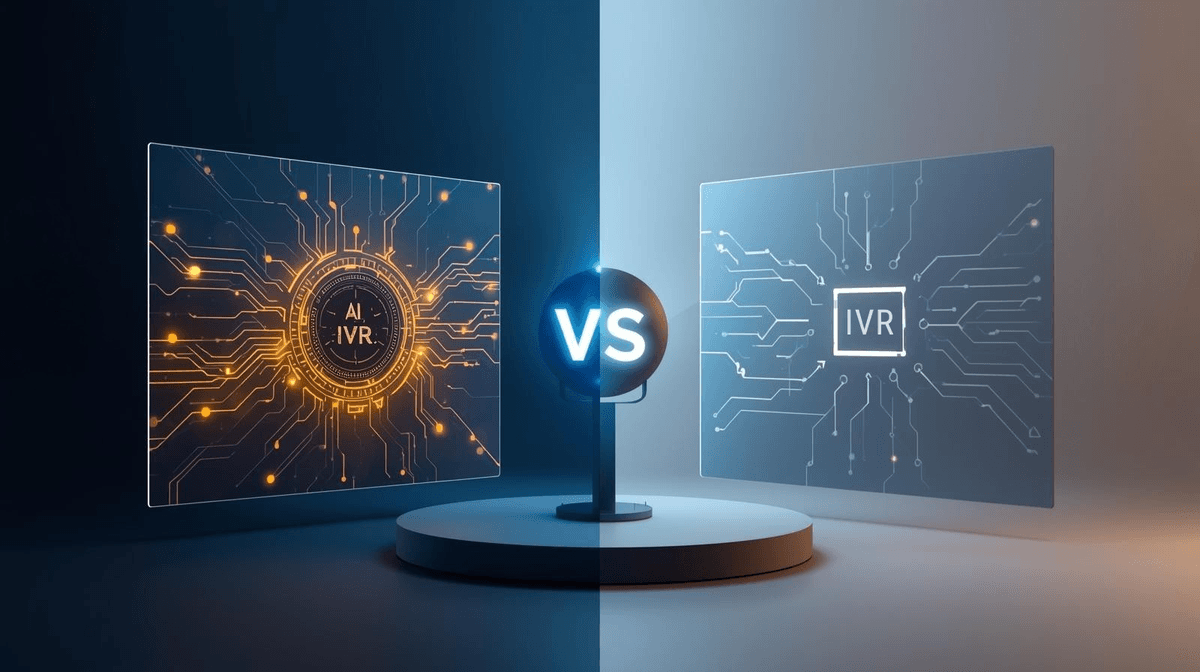
Modern AI call center solutions offer more capabilities than chatbots or interactive voice response (IVR) systems. They use natural language processing (NLP) to understand what a customer is asking, machine learning to improve over time, and intelligent call routing to send conversations to the right destination based on intent, sentiment, history, and context. AI agents can simultaneously manage multiple channels , such as phone, text, chat, and SMS, with no decrease in quality.
Call center AI software also captures and analyzes every interaction in real time, something BPOs can’t. This enables businesses to achieve insight into customer behavior, agent performance trends, and emerging issues without the cost and delay of manual review.
When evaluating the outsourced call center versus AI question, businesses typically weigh cost, scalability, consistency, and the quality of customer satisfaction delivered across interactions. The table below compares the two models across the factors that matter most.
Factor |
Outsourced Call Center |
AI Call Center |
| Availability | Shift-based; gaps during off-hours and holidays | 24/7, no scheduling gaps |
| Scalability | Limited; requires hiring and training to flex | Instant; handles unlimited simultaneous calls |
| Cost Structure | Variable; tied to agent hours and call volume | Predictable; no overtime or staffing surcharges |
| Consistency | Varies by agent; quality fluctuates | Consistent tone, accuracy, and experience every time |
| Call Routing | Manual; relies on transfers and hold times | Intelligent routing based on intent and context |
| Data Handling | Manual CRM updates; prone to errors and delays | Real-time capture and integration |
| Language Support | Dependent on agent pool | Multilingual support across all channels |
| Setup Time | Weeks to months; hiring, training, onboarding | Faster deployment; no agent training required |
| Customer Sentiment Monitoring | Ad hoc; supervisor review | Automated; real-time flagging and insight |
| Handling Complex Issues | Human judgment; better for nuanced situations | Escalates intelligently; AI handles structured tasks |
On paper, outsourcing looks like the lower-cost option. However, the total cost of BPO-managed contact center operations tends to increase quickly and often unpredictably. Hidden expenses include:
In addition to costs, there are service quality costs that don’t show up on an invoice. High staff turnover at BPO providers results in knowledge gaps, inconsistent agent performance, and continuous retraining cycles. Language barriers and cultural differences can frustrate customers and reduce first call resolution rates, and lengthy wait times during peak-hour overload lead to call abandonment and lost revenue.
For most BPOs, manually analyzing the large amounts of data collected in a call center daily is expensive and impractical. This limits the ability to monitor performance, identify trends in customer behavior, or make timely improvements to call center operations.
Customers today expect immediate answers, consistent experiences, and the ability to engage across channels without repeating themselves. Outsourced call centers, many of which are built around shift schedules, script-driven interactions, and manual processes, were not designed to analyze customer demand or adapt to changing needs like AI-powered call centers.
According to Gartner, conversational AI deployment in call centers will reduce agent labor costs by $80 billion in 2026. The research and advisory firm also predicts that AI will autonomously resolve 80% of common customer service issues by 2029. Roughly 60% of customer care leaders expect call volumes to increase, meaning businesses need call center solutions that can absorb demand without proportional headcount growth.
AI call center technology directly addresses this call volume increase. Virtual agents handle routine tasks, such as answering customer inquiries, scheduling appointments, processing orders, and routing calls, while human agents focus on the conversations that require judgment, empathy, or escalation. This scalable self-service enables 24/7 support and intelligent deflection, allowing human agents to focus on complex problems that require specialized expertise. The impact on agent productivity is fewer transfers, faster resolutions, and less time spent on repetitive work that AI can more accurately and consistently complete.
For contact center managers, this also means better data. Call center AI solutions analyze every interaction, flag patterns in customer sentiment, and surface real-time insights that would take weeks to extract manually, making it possible to continuously improve customer interactions and gain a better understanding of the customer journey.
The outsourced call center vs. AI comparison doesn’t have to be an either/or decision. There are situations where human call center agents remain the right answer.
Complex or emotionally sensitive issues, such as complaints involving loss, safety, or high financial stakes, often benefit from human judgment and empathy that AI agents aren’t designed to replicate. Highly regulated industries with manual workflows may require human oversight for compliance reasons. Some businesses might find value in a hybrid approach, in which AI handles volume and virtual agents assist human agents with structured summaries and intelligent routing before transferring.
The work outsourced call centers handle best is the work that requires a human. The work they are routinely assigned, such as answering repeat questions, managing call routing, logging data, and scheduling appointments, is work that AI call center solutions are built to perform better.
One of the most common concerns when evaluating AI-based call centers is whether AI replaces human agents entirely. But, the more useful question is where each performs best.
AI call center agents are best for:
Human agents excel at:
Many businesses are adopting a hybrid model using AI for routine inquiries and self-service while relying on human agents for complex cases. AI-powered call centers don’t eliminate human agents. Instead, they protect human agents from the volume and repetition that causes fatigue, turnover, and declining call quality. When call center AI handles the predictable work, human agents can focus on more complex conversations.
Not all AI call center technology is equal. Center software is the core technology that enables advanced AI features like real-time call routing, automation, and multichannel support. When evaluating call center AI solutions for your business, consider that the best AI call center providers differentiate through industry-specific models trained on vertical-specific knowledge, offering tailored implementations for various sectors. Consider:
Can the system handle natural, non-linear conversations? Does it adapt when a customer changes direction mid-call, or does it break? The best AI call center agents handle intent shifts without losing context.
True AI call center solutions integrate with your CRM, scheduling systems, and operational data in real time, so conversations are informed by customer history instead of generic scripts. Surface-level integrations that only log calls after the fact don’t qualify.
The best call center AI solutions don’t just escalate to humans by default. They use intent detection, urgency prioritization, and structured summaries to route the right calls to the right people at the right moment, which protects agent time and customer experience.
AI-based call centers that handle voice only are only solving part of the problem. Look for solutions that operate as an omnichannel contact center, unifying voice, text, chat, email, and SMS into a single platform. This enables customers to get the same experience regardless of how they reach you. AI-powered virtual agents enable personalized service across voice, chat, email, and social channels while maintaining conversation context.
AI-powered call centers should surface customer behavior trends, sentiment signals, and agent performance data rather than simply logging calls after the fact. The ability to monitor performance continuously is what separates a smart system from a recording tool.
The best AI tools let center managers make updates in minutes. Menus change, policies shift, and priorities evolve, so your AI call center should move at the speed of your business without requiring vendor involvement for every adjustment.
Revmo AI was built for businesses that need more than a smarter phone line. It’s the orchestration layer behind customer interactions that turns natural conversations into real outcomes across voice, text, and chat.
Most AI call center solutions focus on answering the phone, but Revmo AI pulls in real-time business data, triggers the right workflows, and completes each interaction. Here’s what sets Revmo apart:
Natural conversations: Unlike traditional AI voice systems that force customers through linear scripts, Revmo adapts in real time. Customers can state intent however they want, change direction, and still get a resolution because Revmo follows the customer, not a script.
Real-time business data: Revmo integrates with your CRM, POS, scheduling systems, and order history so every conversation is personal and contextual. Customers don’t have to repeat themselves, and interactions feel informed rather than generic.
Autonomous workflows: Revmo supports multiple workflows, including booking, scheduling, ordering, and more through a single conversational engine. Even when direct API integrations don’t exist, Revmo can use autonomous agents to complete workflows that other platforms can’t.
Intelligent escalation: Revmo gives businesses fine-grained control over when and how conversations move to human agents based on intent, confidence, and business rules. Not every interaction should reach a human, and not every customer should be blocked from one.
Omnichannel by design: Whether it’s voice, text, and chat, Revmo delivers the same level of intelligence and consistency across every channel from the start, so customers get the same answers and experience regardless of how they choose to engage.
Is your business ready to move beyond answering calls and start completing them?

SVP of Sales
Specializing in go-to-market strategies, Devon boasts extensive experience as a revenue and growth leader, GTM advisor and sales coach.