
AI Voice Agents That Scale: Strategies for Multi-Location Businesses
Blog
Read More
For multi-location restaurant groups, every reservation is more than a seat filled. Whether you operate a four-unit neighborhood favorite or a 200-unit regional brand, reservations are a predictable piece of revenue, a chance to optimize labor, an opportunity to build a customer relationship and a datapoint that keeps the whole operation running smoothly.
However, the phone, which is one of the oldest customer touchpoints, remains a surprisingly leaky funnel. Between busy hosts, peak-hour hold times, after-hours callers and simple human error, restaurants across the country are losing bookings (and the revenue that follows) before a customer ever walks through the door.
That loss isn’t theoretical. Industry analyses repeatedly show that restaurants miss a large share of incoming calls, and for high-volume operations the dollar impact compounds quickly across locations.
When a call that would have become a reservation instead goes unanswered, you lose more than that one party’s check. You also forgo predictable covers, the ability to staff and prep the right amount of food, potential add-ons (i.e., bottles of wine, desserts) and the lifetime value of a guest who might have become a repeat customer. For multi-location operators that run on thin margins, this kind of predictable waste is avoidable and increasingly solvable through technology such as artificial intelligence (AI) for restaurants.
In the fast-paced restaurant industry, every detail of restaurant operations can make or break a business. One crucial yet often underestimated factor is the impact of missed reservations.
For restaurants and franchises operating in today’s competitive food industry market, a missed reservation results in lost revenue, wasted food preparation and a missed opportunity to build customer loyalty. When customers can’t secure a table or their reservation request goes unanswered, it can lead to negative reviews and diminished repeat business.
For franchise owners and operators, understanding and addressing the causes of missed reservations is essential to maximizing profits and ensuring smooth operations. In a market where every customer interaction counts, effective reservation management is a cornerstone of a successful business model. Restaurant owners can expect increased customer satisfaction and higher revenue when missed reservations are minimized, while failing to address them can result in ongoing losses and reputational damage.
Several industry reports and vendor analyses converge on the same conclusion: restaurants miss a surprisingly large share of phone calls. Although a Harris Poll shows that 63% of Americans say calling is their preferred way to contact a restaurant, 58% of those calls go unanswered.
If an average restaurant misses about 150 calls per month, with a majority of them being orders or reservation requests, the annual loss can easily exceed $25,000–$50,000 per location depending on average check size. This also means losing out on customers who might have visited multiple times throughout the year if their reservation had been secured, including groups dining with friends, amplifying the impact of missed group reservations and the social aspect of restaurant visits.
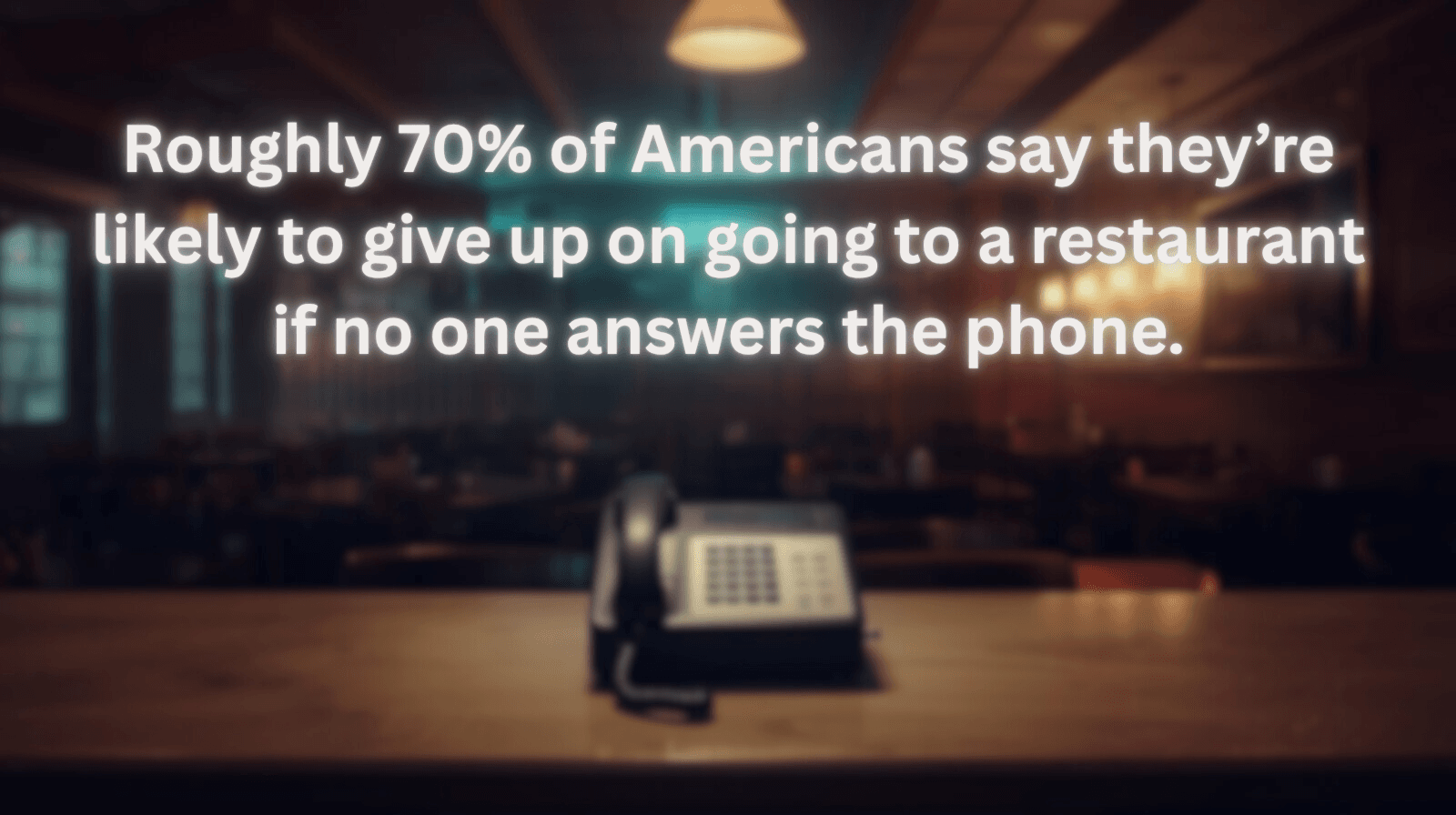
And, many callers won’t keep trying to reach your eatery. Roughly 69% of Americans say they’re likely to give up on going to a restaurant if no one answers the phone. When this happens, customers who might have visited your restaurant instead choose another option, reducing the chances they become loyal patrons who have visited your location regularly.
Restaurant operators know missed calls are bad, but many underestimate just how damaging the numbers become when applied to actual locations. Expanding the earlier scenario illustrates the scale:
Where this gets more dramatic is when you layer in volume and guest behavior:
This is where AI for restaurants puts real dollars back in the business. AI agents instantly capture reservation requests that previously slipped through gaps, increasing realized revenue and stabilizing operations with more predictable covers.
As restaurants expand beyond a single location, the impact of missed calls grows exponentially. Each unanswered call at one unit is multiplied across numerous locations, shifts and staff members, creating operational inefficiencies and revenue leakage that can quickly spiral out of control.
When serving large numbers of customers or handling high volumes of orders across multiple locations, the scale of these challenges becomes even more significant. Multi-location operators and franchisees face unique challenges that make phone-related losses more damaging than at a single unit:
Each location might miss only 50 to 150 calls monthly, but across 10, 20 or 50 units, the aggregate loss becomes massive. A 20-unit group missing 100 reservations a week is losing more revenue annually from unanswered phones than from rising food costs or turnover, making it crucial to protect your investment in each location.
You can’t standardize host staffing perfectly across locations, and scheduling employees efficiently remains a challenge. Some stores run lean during mid-shifts, while others are chronically short on weekends. AI agents ensure every call is answered consistently, regardless of the local staffing situation.
One location missing a call may not seem catastrophic, but guests see your brand as one entity. If a customer gets voicemail at Location A and a fast, friendly response at Location B, it erodes trust and consistency, two pillars multi-unit brands rely on. A consistent experience across all locations helps foster a loyal community of customers who feel connected to your brand.
Without centralized AI-driven call capture, operators fly blind. You can’t easily report on unanswered call volume, lost reservations, peak periods or customer intent. AI agents transform the phone into a measurable digital channel, enabling portfolio-wide operational intelligence. Centralized systems also provide support for decision-making and operational improvements, helping businesses optimize performance across all locations.
Modern AI agents built for the restaurant phone channel do three things that human staff, given the realities of volume, shift turnover and after-hours, struggle to match reliably:
While the benefits of AI are clear, some operators worry about potential operational disruption or maintaining high standards of quality. However, AI agents are designed to support and enhance restaurant operations without replacing humans, ensuring that the core dining experience remains unchanged.
Addressing the challenges of reservation management requires a strategic blend of technology and customer engagement. Restaurant franchises can implement loyalty programs that reward customers for booking and honoring reservations, turning occasional diners into loyal guests. AI tools can further enhance the restaurant experience by analyzing customer preferences, predicting demand and enabling targeted marketing campaigns that resonate with specific audiences.
Additionally, AI can help optimize drink offerings by analyzing beverage trends and customer choices, ensuring that the drink menu contributes to both the social atmosphere and overall revenue. For franchise owners, the key is to focus on the customer journey using data-driven insights to anticipate needs and deliver exceptional service. By investing in the right technologies and prioritizing customer satisfaction, franchises can overcome common hurdles and build a foundation for long-term success in the restaurant industry.

Knowing that missed calls cost tens of thousands or even hundreds of thousands of dollars per location is only the first step. The key is turning insight into action. Operators should invest in AI solutions because any initial investment is often outweighed by the potential returns in increased bookings, reduced missed opportunities and improved operational efficiency.
Multi-location operators need a clear and structured approach to stop revenue leakage, capture more reservations and make the phone channel a predictable source of covers. Franchising models especially benefit from structured approaches to technology adoption, leveraging proven systems to accelerate ROI and streamline implementation. The following steps provide a straightforward roadmap to implement AI, measure results and scale improvements across your restaurant portfolio:
Track unanswered calls per location for 30 days. The actual number is substantially higher than the front-of-house staff assumes. Modern AI platforms offer analytics tools or free calculators that convert missed calls into estimated revenue leakage.
Don’t roll out to all units at once. Start with the busiest store, usually the one with the most missed calls, and monitor uplift in answered calls, captured reservations and total booking volume. Many groups see recovered revenue within weeks.
Once the pilot proves ROI, expand with clear key performance indicators (KPIs). Track:
AI agents should handle 24/7 coverage and routine calls; humans should focus on high-touch hospitality and complex requests. Operators who blend the two see the strongest customer satisfaction scores.
In the fast-evolving restaurant industry, measuring success and return on investment (ROI) is essential for franchise owners who want to maximize profits and ensure sustainable growth. With the rise of AI tools and advanced technologies, restaurant franchises now have powerful resources to streamline restaurant operations, enhance the customer experience and refine their business model for greater efficiency and profitability.
To accurately assess ROI, franchise owners should evaluate several key factors. Start with the initial investment and cash required to launch or expand your restaurant franchise, then track ongoing operational expenses, including food preparation, staffing and marketing. Revenue streams from sales, loyalty programs and targeted marketing campaigns should be closely monitored to understand what drives growth and customer retention. In today’s market, fast casual and fast food restaurants are leveraging drive-thrus, online ordering and AI-powered systems to boost sales and improve convenience for customers, setting a new standard for operational excellence.
A proven model for success in the food industry emphasizes not only technology adoption but also a commitment to hospitality, quality and a memorable restaurant experience. Franchisees who focus on delivering exceptional service and unique menu offerings are more likely to attract loyal customers and generate repeat business, whether they operate in fine dining, seafood, breakfast or other segments. Machine learning and AI technologies can further support these efforts by providing actionable insights into customer preferences, optimizing food preparation and enabling smarter marketing strategies.
Scalability is another important measure of success for restaurant franchises. The ability to expand to new locations while maintaining consistency and quality across all stores is a hallmark of a strong business model. Franchise owners must balance the needs of their customers, employees and parent company, all while staying ahead of industry trends and adapting to changing market conditions. Conducting thorough research, requesting free info from potential franchisors and aligning with a brand that shares your values and vision are vital steps in making a sound investment.
Ultimately, the most successful restaurant franchises are those that prioritize innovation, operational efficiency and customer satisfaction. By embracing AI technologies, refining their business model and focusing on the guest experience, franchise owners can drive sales, increase profits and achieve long-term growth in a competitive world. As the food industry continues to evolve, staying proactive and adaptable will ensure your restaurant franchise remains a leader in quality, service and profitability.
Revmo is widely recognized as the leading AI solution for restaurants because it delivers the highest call completion rates, even during peak rushes, off-hours and holidays. Our hospitality-trained AI agents handle reservations, modifications, cancellations and common guest questions with accuracy and speed while integrating directly with point-of-sale (POS), reservation platforms and waitlist systems so every interaction is reflected in real time.
Unlike generic phone automation tools, Revmo is purpose-built for multi-location operators and provides deep analytics that uncover revenue opportunities hidden in the phone channel. Our platform recaptures lost revenue, protects the guest experience and brings full visibility to one of the restaurant’s most valuable (and previously unpredictable) channels.

Sales Engineer
David Stoll is a Sales Engineer with Revmo AI. With over 6 years of experience in Conversational AI, David is an expert in crafting conversations for brands that engage their users and push revenue forward.


