The Complete Guide to AI for Restaurants: Tools, Strategies, and Real ROI
Blog
Read More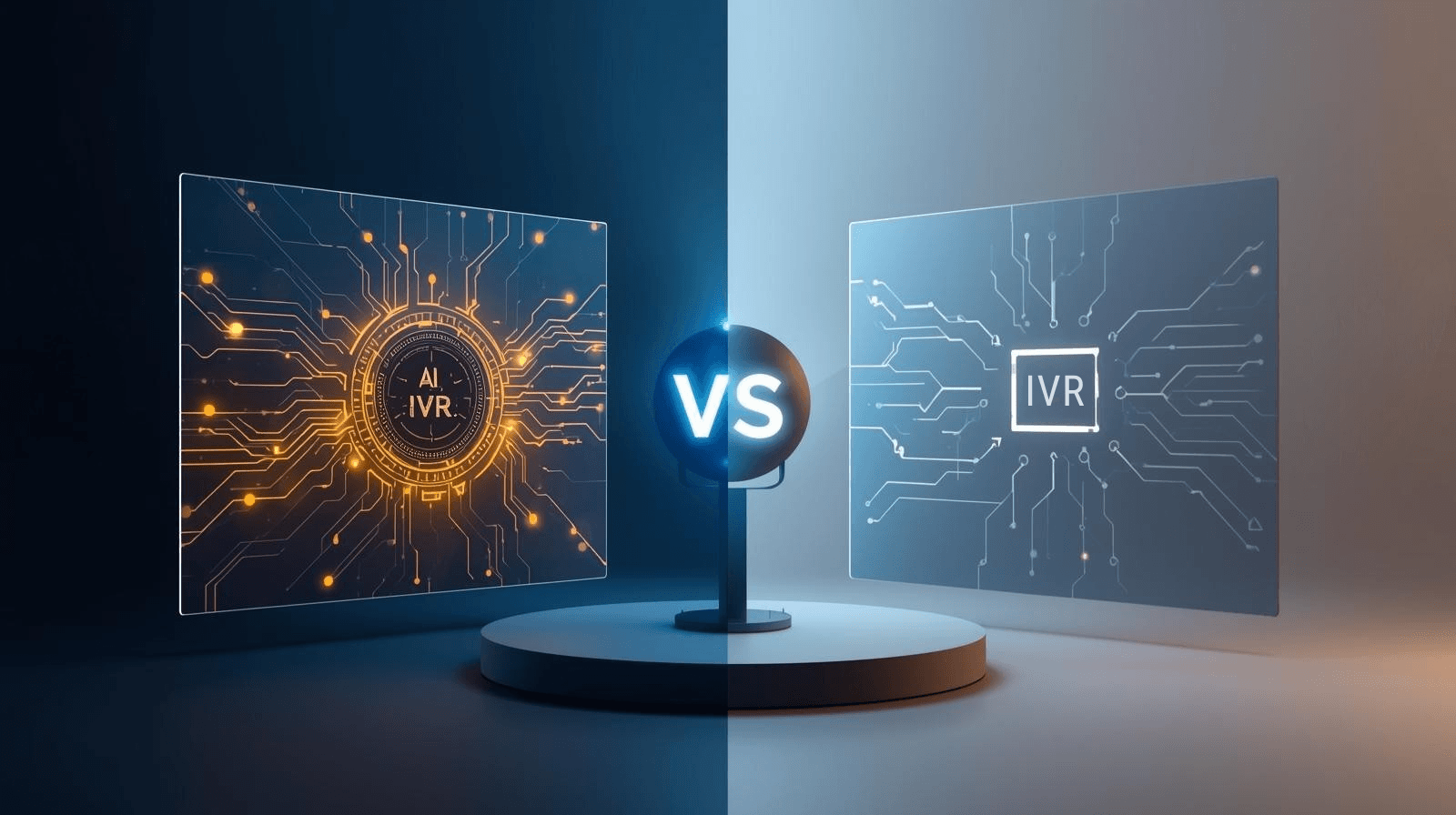
Do you remember when the first smartphones emerged onto the market? Touch screens, GPS, cameras, the availability of third-party applications, and internet access made these products a hot commodity.
Fast-forward approximately 20 years, and the adoption of this technology is widespread. More than 90% of Americans own a smartphone. These products now include 5G connectivity, face-scanning technology, advanced cameras, voice assistants, bionic chips, and other features.
Interactive voice response (IVR) systems have also undergone big changes since their commercial introduction use in the early 1970s. Evolving from a call routing tool to a customer service strategy, today’s IVR technology relies less on rigid, menu-driven interactions. Instead, it employs artificial intelligence (AI) that promotes more conversational and personalized interactions.
The gap between legacy systems and AI IVR has widened considerably. This guide breaks down what’s actually changed in the AI IVR vs. IVR conversation, so you can evaluate which approach best fits your business needs.
An IVR system is an automated phone solution that lets callers navigate menus using keypad inputs or limited voice commands. For decades, these platforms have been the standard for managing inbound calls in contact centers across almost every industry.
IVR systems are often linked to specific phone numbers, allowing businesses to manage inbound calls, route requests, and provide services across different phone number types and regions. They rely on dual-tone multi-frequency (DTMF) signaling, also known as touch-tone data entry, to interpret caller input.
Different types of IVR solutions offer varying levels of features. Directed dialogue systems use scripted menus with a predefined set of replies, while touch-tone replacement IVR relies entirely on DTMF signals. Natural language IVR uses natural language processing (NLP) and basic automatic speech recognition (ASR) to interpret requests more naturally, directing callers with a conversational prompt instead of a numbered list.
These automated solutions are used across industries to improve efficiency and handle customer service at scale. A contact center typically deploys one of these IVR solutions to handle high inbound volume. However, the tree-based structure of IVR technology, through which callers progress through predetermined branches, has become a source of friction for modern customers.
Built around a branched logic format, these legacy systems use a tree-based structure designed for call containment, which is defined as preventing calls from reaching human agents. Callers listen to menu options, then press specific buttons that correspond to different paths. The call flow is entirely predetermined and designed by the business instead of what callers need.
Some platforms have added basic ASR to allow voice commands instead of button presses, but the underlying architecture still forces customers into a fixed decision-making process. If a caller’s request doesn’t fit a predefined category, the system has no good answer, often resulting in a dead end where the caller receives no helpful fallback.
How well a system performs is measured by call containment. Success is measured by how many calls are “handled” by the automated phone system, whether or not the caller’s need was actually met. Updating these platforms requires reprogramming, re-recording, and redeploying menu prompts, which makes IVR slow and expensive.
Legacy phone systems often leave gaps because callers get stuck in menus, staff spend time on repetitive inquiries, and revenue opportunities are lost. The rigidity of these platforms leads to frustration and high call abandonment. These inefficiencies contribute to operational strain, increasing the workload on support teams and driving up costs.
About 60% of customers who wait on hold too long will just hang up. Customers who wait longer than expected are 18% less satisfied with their overall experience. When those customers hang up, they also stop buying.
Problems with legacy IVR systems go beyond hold times, making them consistently fall short in:
As McKinsey & Company notes, most utility IVR systems still have substantial capability gaps and run inefficiently. Combined with poor feedback loops, these limitations increase the cost per call and erode the caller experience over time. Traditional IVR systems are built to manage volume, not understand intent or deliver the self-service experience most customers expect.
Voice AI is a voice system that can interpret conversational speech and understand a caller’s context and intent. These platforms use artificial intelligence technologies, such as NLP, natural language understanding (NLU), and machine learning (ML), to analyze spoken input and respond in a natural and contextually relevant way.
Traditional IVR systems rely on rigid menus and basic voice recognition, but AI IVR supports open-ended, human-like conversations. Callers can speak naturally, and the system adapts in real time.
This technology route calls rather than simply resolving them. A well-deployed voice AI platform handles a wide range of customer requests without human intervention, enabling it to:
AI IVR is powered by complementary technologies. ASR transforms spoken language into text, NLP analyzes context and intent, and machine learning identifies patterns across interactions to improve accuracy over time. Text-to-speech (TTS) converts responses into natural-sounding speech using generative AI models, making each phone call feel fluid, not robotic or recorded.
AI models can now detect language and accent in real time and adjust responses accordingly, eliminating the need to pre-record dozens of prompts. They also ensure a consistent customer experience across every contact center location.
One of the biggest differences between AI IVR and IVR is how each system structures interactions. Tree-based systems force customers into a predetermined process, but conversational systems allow customers to express their needs naturally and let the platform adapt to them.
NLP makes this possible by analyzing the meaning behind a caller’s words, so the system understands intent, even when phrasing varies or a caller changes direction mid-interaction. NLU interprets context, which permits the system to handle multi-turn conversations without losing track of what the caller needs.
Real-time speech recognition empowers AI IVR systems to process and respond without perceptible delay, which is a crucial factor in whether a voice interaction feels natural or robotic. When combined with intent recognition, real-time speech recognition equips voice AI to understand what a customer is trying to accomplish and move things forward accordingly.
Customers don’t think or speak in the linear order prompted by rigid menus. Voice AI supports human-like conversations that adapt to the caller in real time. A conversational AI IVR maintains context throughout the interaction, so callers can talk freely without being forced back to the beginning of a menu when their request shifts.
| Capability | Traditional IVR | AI IVR |
| Interaction Model | Rigid menus; keypad or limited voice commands | Natural language; speak freely in any order |
| Call Routing | Basic routing by menu selection | Intelligent routing based on real-time intent recognition |
| NLP / NLU | None or basic keyword detection | Full NLP and NLU; understands context, sentiment, and intent |
| ASR Accuracy | Limited; struggles with accents and natural speech | High accuracy; adapts to accents and languages in real time |
| Self-Service | Limited to predefined paths | Handles a wide range of requests autonomously via AI agents |
| Workflow Completion | Routes calls; cannot complete tasks | Executes entire tasks: manages appointments, payments, bookings |
| Personalization | None; pre-recorded responses for all callers | Pulls from customer data and CRM for personalized interactions |
| Escalation to Live Agent | Rule-based fallback; often misrouted | Escalation based on intent, confidence, and sentiment detection |
| Omnichannel Support | Confined to phone interactions | Consistent across voice, text, and chat |
| Updates and Iteration | Requires manual reprogramming and re-recording | Updates applied in minutes; no reprogramming required |
| First Call Resolution | ~25% resolved without agent transfer | ~55% resolved without agent transfer via voice AI |
| CSAT Score | Often low; high abandonment, long wait times | Higher scores; faster resolutions, lower call abandonment |
| Cost Per Call | Higher cost due to inefficiency and agent dependence | Reduced cost per call through automation |
| Contact Center Impact | High volume of escalations consumes agent time | Absorbs growing call volume; frees agents for high-value work |
The shift to voice AI is a direct response to changing customer expectations. Research shows that 81% of customers prefer companies that offer a personalized experience, something legacy phone systems can’t deliver.
AI IVR platforms automatically handle requests without requiring human intervention. Routine requests, such as managing appointments, processing orders, or confirming reservations, are handled instantly. This frees staff to focus on complex, high-value work, resulting in lower operational costs, faster resolutions, and shorter hold times.
AI-powered IVR systems deliver a fivefold improvement in customer satisfaction scores, accelerate issue resolution, and reduce the number of live-agent calls by more than 10%. Voice AI resolves 55% of calls without agent transfer, compared to just 25% for legacy systems.
For contact centers trying to manage growing call volume without adding headcount, AI IVR systems handle high call volumes simultaneously. This ensures no inbound call goes unanswered, even during periods of high-volume demand.
Unlike traditional IVR platforms, AI-powered systems can quickly be adjusted. Staff can update call flow, hours, policies, or agent behavior in minutes without operational disruption. Custom IVR built on AI also integrates with existing tools, such as CRM platforms, scheduling software, and POS systems, so every interaction is informed by real customer data.
How quickly and accurately a caller gets what they need is the biggest driver of a positive phone experience. A study conducted by the American Customer Satisfaction Index (ACSI) found that a short wait time is one of the top drivers of customer satisfaction. Seventy-five percent of consumers rank long waiting times as a major customer service frustration.
Legacy phone systems often make wait times worse. When callers can’t navigate a menu, they cycle through options or hang up. When the automated system misreads their words, they have to repeat themselves. If the phone system can’t direct callers correctly the first time, they end up waiting for an agent transfer anyway, eroding the caller experience.
By understanding natural language and autonomously resolving interactions, AI IVR systems shorten wait times, reduce escalations, and ensure callers reach the right outcome on the first request. First call resolution improves, call abandonment declines, and the overall experience improves, resulting in customer satisfaction, lower churn, and stronger brand loyalty.
For most contact centers, every interaction that escalates to an agent has a cost, and each transfer, callback, or repeated call represents a gap in how well the platform resolves interactions. Legacy phone systems were designed to contain calls, but containment is not the same as completion. A phone system that routes a caller to the wrong department or can’t answer a question outside its predefined menu fails to resolve a customer interaction.
By resolving interactions instead of only routing them, voice AI systems reduce the number of calls that require human intervention. They manage growing call volume while absorbing spikes without proportional increases in staffing, creating options for reallocation, redeployment, or right-sizing and freeing teams to focus on revenue-producing tasks.
AI agents consistently outperform legacy systems by delivering conversational, context-aware interactions that go far beyond simple menu navigation. Unlike traditional IVR systems, which primarily route calls, AI agents complete tasks and can manage appointments, follow up via text or email, detect upsell opportunities, process payments, and interact with web-based systems to complete workflows.
Traditional IVR systems force customers into a predetermined path. AI agents follow the customer, maintain context across turns, remember previous interactions, and adapt when intent changes. The difference is a faster and more personalized and accurate experience.
AI agents provide smarter escalation to live agents. AI-powered IVR systems escalate based on intent, confidence level, and real-time sentiment detection. The right conversations reach humans, and the rest get resolved autonomously. When a customer does need a live agent, full conversation history is passed along so the caller doesn’t have to repeat themselves. For businesses dealing with sensitive information, such as payments, personal data, and compliance, AI IVR systems provide continuous monitoring for regulatory adherence, reducing risk across the contact center.
Revmo is the orchestration layer behind modern customer interactions, turning each interaction into a real outcome across voice, text, and chat. Unlike traditional IVR systems that rely on rigid scripts, isolated integrations, and human fallbacks, our platform coordinates context, systems, and actions, allowing interactions to be completed.
Most voice AI solutions focus on answering the phone. Revmo goes further by pulling in the right context, triggering the next steps, and seeing each interaction through to resolution across locations, systems, and channels. The system adapts in real time to maintain a consistent, brand-specific customer experience, even for after-hours calls.
The Revmo AI platform is designed to be user-friendly and does not require specialized technical expertise for setup or management, making it accessible to a wide range of users. It integrates with the tools and systems your business already uses, so every interaction is informed by real customer data. When an interaction needs to reach a live agent, Revmo’s intelligent escalation control passes full conversation context along, facilitating a smooth handoff.
For businesses looking to improve customer service and deliver consistent self-service at scale, our AI IVR solution delivers measurable results. Whether you operate one or multiple locations, Revmo moves at the speed your customers expect.

Sales Engineer
David Stoll is a Sales Engineer with Revmo AI. With over 6 years of experience in Conversational AI, David is an expert in crafting conversations for brands that engage their users and push revenue forward.